


Updated: August 14, 2026
If you’ve been house hunting in Portugal, you’ve probably noticed a pattern: Many local and foreign buyers prefer to be near water.
About 85% of housing demand in Portugal is focused along the coast. Lisbon, Porto, and Setúbal alone are the main hubs, accounting for more than half of the national demand. But, that same data tells a more layered story.
The interior regions across the Portuguese real estate market are not ignored. Instead, they are holding up better than the coast during the market’s summer slowdown, with a handful of inland towns registering the fastest growth rates in Portugal.
If you are weighing out your options of buying a coastal property versus further inland, then this article is for you. Here’s the latest data on property demand in Portugal for 2026.
Portugal's Housing Demand: Market Overview
Across Q2 2026, coastal areas kept their grip on Portugal’s real estate market, but the pace of demand told a different story than some might expect.
Searches on the coast dropped 25.3% between April and June, while interior searches fell by a smaller 21.2% over the same period — a sign that buyer interest inland is more stable, even if rental yields and appreciation potential can be lower.
In-demand locations
In Portugal, three coastal locations had the highest demand. Lisbon represents 22.9% of all property searches, Porto at 20.2%, and Setúbal at 10.4%. Together, these coastal areas make up more than 50% of all properties searched in Portugal. The various job opportunities, international schools, airports, and modern infrastructure are the main reasons behind their growing popularity.
However, when it comes to the cost of housing in Portugal, coastal areas such as Lisbon, Porto, and Setúbal come with very high property prices. As a result, many buyers move inland. That’s where Santarém stands out.
Based on the new study, Santarém is among the top inland regions, where the demand for housing has reached 37.1%. One of its main benefits is the proximity to the Lisbon Metropolitan Area and the options for lower entry prices.
Info | Coast | Interior |
Most in-demand hubs | Lisbon (22.9%) Porto (20.2%) Setúbal (10.4%) | Santarém (37.1%) |
Price evolution | Lisbon (−5.9%) Madeira (−6.7%) Azores (−13.0%) | Castelo Branco (+16.7%) Beja (+9.0%) Portalegre (+7.7%) Bragança (+6.7%) Guarda (+6.2%) |
Most searched property types | T3 and T4 properties | T4 properties |
Coastal vs Interior Property Prices: The Price Gap
House prices in Portugal are one of the main reasons why demand is often split between coastal and interior regions. This difference becomes particularly clear when you look at the price per square meter.
According to Confidencial Imobiliário Q4 2025 data, property prices in Portugal’s main regions are:
Region | Price per square meter |
Lisbon Metropolitan Area | €5,045 |
Porto Metropolitan Area | €4,052 |
Northern Portugal | €2,070 |
Central Portugal | €2,172 |
Alentejo | €3,958 |
The Algarve | €4,550 |
Inland, particularly in Guarda, Bragança, Évora, and Santarém, properties are on the cheaper side.
The average home costs €1,092/m² in Guarda, €860/m² in Bragança, €1,760/m² in Évora, and €1,674/m² in Santarém municipalities, as stated by Idealista price reports from July 2026. Individual parishes, however, have higher prices, such as €2,684/m² in Évora parish and €1,125/m² in Bragança parish.
That means, in the Lisbon Metro Area, an average 100 m² property would cost around €504,500, while the same-sized property in Bragança municipality would be roughly €86,000.
Portugal Housing Market: Price Evolution
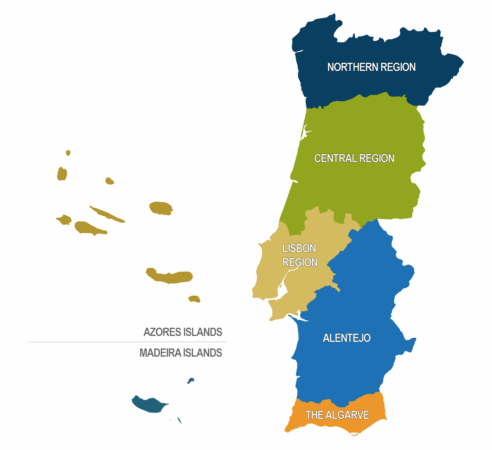
In inland areas, the increase in prices was as follows:
- Castelo Branco (+16.7%)
- Beja (+9.0%)
- Portalegre (+7.7%)
- Bragança (+6.7%)
- Guarda (+6.2%)
All of these inland locations had buyers who searched for “properties at higher prices”, which means they are more confident in these markets.
On the coast, the exact opposite was recorded:
- Lisbon (-5.9%),
- Madeira (-6.7%)
- Azores (-13.0%)
All of these coastal locations saw the price range buyers were searching in pull back. This means that Portuguese buyers continue to focus on family homes at more reasonable prices.
What buyers are actually looking for?
The top searches included houses in Portugal with four bedrooms (T4) at about 33.5% and properties with three bedrooms (T3) at around 31.9%. In other words, these two property types account for roughly 65% of searches carried out during the study.
When it comes to housing demand in Portugal based on property types, T4 is a top choice in every single district analyzed. On the coast, only Porto and Braga break from the T3/T4 pattern by favoring three-bedroom homes as the most-searched layout.
A four-bedroom home has a median asking price of €310,000 on the coast versus the typical €195,000 inland. In Bragança specifically, the average T4 asking price is just €138,750, which is less than 50% of what a similar property costs based on the coastal benchmark.
Read our ultimate guide to buying property in Portugal as a foreigner

Growing Municipalities Against the National Trend
Certain municipalities in Portugal went against the national trend. Inland, Miranda do Douro posted the strongest growth in the country at 87.9%, followed by Macedo de Cavaleiros (+39.3%), Vouzela (+27.3%), Celorico da Beira (+24.1%), and Portalegre (+15.7%).
On the coast, Paredes de Coura recorded staggering growth rates (+63.0%), followed by Pampilhosa da Serra (+30.0%), Pedrógão Grande (+22.9%), and Estarreja (+16.5%).
Albufeira, up 15.2%, recorded the highest absolute growth in Portugal’s housing demand of any coastal municipality in Q2 2026. That’s quite a noteworthy increase, given it was already a high-demand area to begin with.
What This Means for Buyers and Investors
To sum up, these trends mean that although the demand across the Portugal housing market is focused along the coast, inland areas are not homogeneous zones.
These locations continue to gain momentum, especially among property buyers seeking lower entry prices, larger living spaces, and a good balance between affordability and quality of life.
Overall, the Portugal real estate market outlook for 2026 and beyond appears to be heading in a positive direction. Considering Lisbon property prices are skyrocketing, many local and foreign buyers prefer inland regions. This shift, in turn, boosts property values there.
Goldcrest: How We Can Help You
Goldcrest is the first buyer’s agent in Portugal. We provide expert, impartial advice on real estate investments and how to buy property in Portugal. From scouting out the perfect property through to property acquisition, we have you covered throughout the process.
Unlike traditional real estate agents in Portugal who represent the seller, we are dedicated exclusively to protecting the buyer’s interests.
If you are looking to purchase property in Portugal, don’t hesitate to get in touch. Our team of skilled experts is available to solve all your real estate doubts, helping you with the property search and offering insightful expertise and strategic advice.
Why choose Goldcrest?
- Local knowledge: With offices located across Portugal, our presence nationwide allows us to assist you personally across the country.
- Independent service: As an independent buying agent, we do not represent any development or project. Our service is entirely tailored toward each individual client, providing you with everything you need to secure the perfect property at the best possible price.
- Streamlined process: Our real estate agents speak English and Portuguese, and our service is completely focused on providing you with a hassle-free buying experience, saving you time. We can also help you buy property remotely.
- Experienced team: Our expert real estate team has a vast local knowledge of the Portuguese property market. We have cutting-edge technology and metasearch tools at your disposal to provide full market coverage, ensuring the best investment choices and negotiated prices.
- Network of partners: We have a close network of partners, including lawyers, property management services, builders, architects, designers, and landscape gardeners, again saving you time and hassle by providing you with trusted experts in their field of work.
Frequently Asked Questions about Housing Demand in Portugal
Why does the coast account for 85% of housing demand in Portugal?
Coastal areas, especially Lisbon, Porto, and Setúbal, have the highest housing demand in Portugal because they offer some of the best job opportunities, transport links, international schools, and lifestyle appeal, although property prices there are well above the national average.
Is demand for property in inland Portugal growing?
Yes, relatively. Portugal’s inland regions fell less sharply than coastal property searches during Q2 2026 (21.2% vs 25.3%), and several inland municipalities, led by Miranda do Douro, posted the fastest growth rates in the country.
How much cheaper is property in inland Portugal compared to the coast?
There is a gap of around 50% to 60% between inland and coastal property prices in Portugal. For example, if you were buying a 100 m² property, the average price would be around €455,000 in the Algarve, compared with roughly €176,000 in Évora municipality. That’s about a €279,000 price difference for the same floor area.
Which Portuguese areas have the highest and lowest property prices?
Lisbon itself and Cascais have the highest average asking prices on the coast at €7,086 and €7,327 per m2, respectively, while Bragança municipality has the lowest in the country at around €860 per m2.
What home size are most buyers in Portugal searching for?
Four-bedroom (T4) and three-bedroom (T3) properties together make up about 65% of all searches in Portugal, with T4 the top choice inland and in most coastal districts, and T3 preferred only in Porto and Braga.
Which areas are seeing the fastest-growing housing demand in Portugal?
Housing demand in Portugal is highest in Miranda do Douro (+87.9%) for inland growth, while Albufeira posted the highest absolute increase in housing demand among Portugal’s coastal locations.
