Home » Real Estate » Retiring in Portugal: A Complete Guide for 2026
Updated: August 21, 2026
Portugal is famous for its sandy golden beaches, stunning natural beauty, traditional Fado music, warm climate, and welcoming culture.
Retiring in Portugal is a popular choice for expats who want to live a comfortable lifestyle at lower prices than in many other Western European countries and the United States.
Whether you want to retire in Portugal’s historic cities, coastal regions, or rural areas, you are in the right place. We will cover the best places for international retirees, the different visa routes, average expenses, and more.
Portugal has a population of over 10,694,681, according to the World Bank, with most expats living in major urban and coastal areas like Lisbon, Porto, Faro, and Setúbal.
Most non-EU and American retirees with a passive income choose the D7 Retirement Visa to move to Portugal, while expats who prefer to invest opt for the Golden Visa.
The official language is Portuguese, but a large portion of the population speaks English, especially in major cities and tourist destinations.
Portugal has a double tax treaty (DTT) with over 80 countries, which means you won’t be taxed twice on the same income if your home country has a tax treaty with Portugal.
Why retire in Portugal?
So, why do retirees choose Portugal in 2026? Retiring in Portugal offers access to a coastal lifestyle with sun-soaked beaches, delicious, traditional Portuguese food and wine, and a lower cost of living than much of Western Europe, the United States, and Canada.
Retirees benefit from a well-established expat community, especially in areas like Lisbon, Porto, and the Algarve. To top it off, the country has its very own Portugal Retirement Visa (D7), which draws foreign retirees from outside the EU with stable passive income.
Here are some of the main benefits of retiring to Portugal:
Sunny climate: Portugal has a Mediterranean climate, which is perfect for foreign retirees who prefer 300 days of annual sunshine. The southern areas have mild winters and warm summers at about 16–18℃ (60–65℉), while Northern Portugal is a bit cooler and more comfortable to enjoy retirement with average temperatures of 10–12℃ (50–53).
Safe and peaceful environment: Portugal is one of the safest countries in the world, ranking 7th in the 2025 Global Peace Index with a score of 1.371, because of its low rates of violent crimes. As a retiree, you can explore vibrant cities at night, local tourist attractions, and rural areas, and still feel safe.
High-quality healthcare: Portugal’s healthcare system offers excellent healthcare access based on EU standards and at affordable costs. Portugal ranks 20th in the world in the 2025 CEOWORLD Health Care Index. When you retire to Portugal from the USA, you can expect high-quality medical services at a fraction of the cost. For example, generic drugs and prescription medicine are around 75 percent cheaper than in the United States.
Affordable cost of living: Many retirees from the US, Canada, and most Western European countries benefit from Portugal’s lower cost of living. To put it into perspective, the cost of living in Portugal is 28.7 percent more affordable than in the United Kingdom, 29.3 percent cheaper than in the United States, and 27.7 percent more affordable than in France, and 5.9 percent lower than in Spain (excluding rent).
Warm and welcoming people: Many people speak English, and they are known to be friendly and welcoming to expats. Retirees in Portugal often find themselves enjoying the Portuguese culture, chatting with neighbors at a local café, joining expat clubs, and taking part in local festivals.
Diverse lifestyle options: Expat retirement in Portugal can fit any lifestyle. Whether you enjoy the busy cities of Lisbon and Porto, the stunning views of the Douro Valley, the quiet medieval villages further inland, or the sunny weather on the Algarve coast, there is something for everyone.
Flexible retirement opportunities: Portugal has different visa routes for non-EU retirees and a relatively straightforward process for EU retirees that doesn’t require any visas. When you retire to Portugal from Canada, the USA, Brazil, or any other non-EU/EEA/Swiss country, you can apply for residency through the Portugal D7 Visa (for passive income earners and pensioners), Golden Visa (for investors), Digital Nomad Visa D8 (for remote workers and freelancers), among others.
Retiring in Portugal: Pros and Cons
Portugal is a dream retirement destination for many pensioners and passive income earners. Here are some of the consistent reasons expats are retiring in Portugal from USA, UK, Canada, Brazil, and other countries.
Weather: Plenty of sunshine with long summers, mild winters, and a refreshing sea breeze along the Atlantic coast.
Safety: Portugal’s safety ranking is very high, where retirees can face occasional petty theft in large cities and crowded tourist zones.
Walkability: Cities like Lisbon, Porto, and Faro are very walkable, with cobblestone streets (calçadas), pedestrian shopping streets, and flatter areas around the riversides and beaches.
Healthcare: Pubic healthcare services (SNS or Serviço Nacional de Saúde) are accessible to all residents with the same benefits as Portuguese citizens.
Community: Portugal has a constantly growing expat community in coastal areas and major cities, mainly from the United States, the United Kingdom, Brazil, Cape Verde, Romania, and Ukraine.
Lifestyle: Retiring in Portugal means that most of your daily life will revolve around the golden beaches, local culture, stunning countryside, and warm climate. Retirees enjoy a slower, more laid-back pace of life.
However, just like anywhere else in the world, Portugal is not without flaws. These are the downsides of retiring to Portugal.
Slow bureaucracy: Appointments with the AIMA (Portugal’s immigration authorities), applying for a residence visa, and other administrative tasks can take longer than most foreigners expect.
Rising housing costs: Portugal’s House Price Index (HPI) saw a 17.6 percent year-on-year increase, which means areas like Lisbon, Porto, and the Algarve have become more expensive for real estate purchases and renting.
Language barrier exists: Although there are many English-speaking expats and locals who speak English and other foreign languages, the local tax authorities, bureaucratic system, smaller towns, and rural areas often require Portuguese to get around.
Slower emergency services in rural areas: Outside major cities, emergency services with public healthcare can be slower, not many physicians speak English, and there is limited specialized medical support.
Limited public transport in rural areas: Inland villages and smaller towns often lack train and bus services, which is why many retirees use cars for appointments, leisure, and daily errands.
Lack of central heating: Older homes in Northern Portugal can feel chilly in winter, as many lack proper insulation, while older apartments can feel less comfortable in the south due to a lack of air conditioning.
Who can retire in Portugal?
“Can I retire to Portugal from the UK?” This is a common question from many of our clients.
The truth is, anyone can retire in Portugal, but the process varies based on nationality. European Union (EU) nationals, European Economic Area nationals, and Swiss nationals can reside freely, with EU nationals only needing to get a Certificate of Registration after three months.
Non-EU nationals, however, must obtain a visa or residency permit to retire in the country, but the process is largely straightforward.
EU/EEA/Swiss retirees
Retiring in Portugal as an EU citizen is simple. If you already have a place to stay, you can move tomorrow. If you are interested in buying property in Portugal, a buyer’s agent like Goldcrest can help with buying and renting, research the real estate market, and negotiate the best property prices.
Thanks to the freedom of movement within the EU, you do not need a visa to live in Portugal. You can relocate without applying for a visa. For example, retirees from France often choose to swap colder, wetter winters for Portugal’s mild and sunny climate.
If you plan to stay within a 180-day period, you must register as a legal resident with your local municipality (Câmara Municipal). You apply for an EU Registration Certificate (Certificado de Registo de Cidadão da UE) with your EU passport and Portuguese tax number (NIF). The fee for CRUE in Portugal is €16 ($18) for adults and €7.50 ($8.45) for children under 6 years old.
Non-EU retirees
Wondering how to retire in Portugal from the USA? If you’re from a country outside the European Union (EU) or the European Free Trade Association (EFTA), you need a residency visa before retiring in Portugal.
A residency visa lets you live legally in Portugal. It also opens doors to Portuguese and EU citizenship. This makes it ideal for retirees who want to make Portugal their home.
Portugal offers different types of residency visas. Some are for work or study, but the ones most suitable for retirees are investment-based or passive-income-based visas. The three most popular options are the Golden Visa, the D2 Visa, and the D7 Visa. Check our ultimate guide for more information about Portugal visas.
What are the requirements for retiring in Portugal?
To qualify for retirement in Portugal, you need to:
Be 18 years or over
Have a valid passport or national ID card
Have a Portuguese tax number (NIF)
Show proof of accommodation in Portugal, such as a recent utility bill, property deed, or rental agreement
Show proof of sufficient funds, such as a recent payslip, employment contract, or proof of pension
Have a clean criminal record
Have a valid health insurance
Be willing to maintain your residency in Portugal
Visa Options and Requirements for Retiring in Portugal
Immigrating to Portugal requires careful planning, especially for non-EU applicants. For retirees, Portugal offers many options to obtain a residency status. Non-EU citizens need a residency visa to live legally, while EU citizens can register more easily. You’ll need health insurance, proof of income, and a clean criminal record.
Below, we’ll cover the visa options for retiring in Portugal as an American or an expat outside the EU/EEA/Swiss area.
Portugal D7 Visa
Portugal is one of the easiest places to get residency for Americans retiring in Portugal and other non-EU nationals.
The Portugal D7 Visa (also known as the D7 Visa or Retirement Visa) is a good choice and is the visa most retirees use to live in Portugal long-term. To be eligible, you need to provide income proof of at least €920 ($1,030) per month.
Your passive income can be from a pension scheme, retirement savings, or any other benefits from social security in your home country.
In order to apply for the visa, you need to:
Be a non-EU national
Earn a passive income of at least €920 ($1,030) per month or €11,040 ($12,430) per year (your income can be pension income, social security benefit, transferable equity, real estate, intellectual property, or financial equity)
Show proof of a place to live in Portugal
Be willing to reside for more than 183 consecutive days per calendar year in Portugal
Portugal Golden Visa Program
The Portugal Golden Visa, also known as the residence permit for investment activity (ARI), is a five-year residency-by-investment scheme for non-EU nationals with minimum investment requirements starting from €250,000 ($281,500). If you have enough finances to invest in Portugal, the Golden Visa Program can be the best option to retire in Portugal.
Scientificresearch: Minimum €500,000 ($563,000) investment in science or technology research
Subscriptiontoaqualifiedinvestmentfund: Contribute at least €500,000 ($563,000)
Jobcreation: The incorporation of a company and the creation of ten jobs worth at least €500,000 ($563,000)
Donation: Make a minimum €250,000 ($281,500) donation to support the arts or the restoration of national heritage
If you meet all the requirements to become an EU citizen under Portuguese nationality law, you can apply for permanent residency and Portuguese citizenship after five years.
As a Portuguese citizen, you will have several benefits, including voting in Portugal and membership in the EU. Portugal provides dual citizenship as well.
The Portugal D2 Visa is for foreign entrepreneurs who want to do business in Portugal. You can buy a local company, invest in shares, create a branch of an existing company, or start a new business.
There is no minimum investment amount for your business.
To apply for the business visa, you:
Must provide a business plan showing how your company will grow
Need at least €11,040 ($12,430) to cover living costs for your first year in Portugal
Have enough savings to support yourself and your business
Must live in Portugal and actively run your business while renewing your residency permit
Check our guide for buying property in Portugal by local experts
After you choose the appropriate visa, retiring in Portugal often follows a series of steps and timelines that vary based on your preferred residency pathway. But most non-EU retirees retire in Portugal based on the following immigration process:
Step 1: Select your residency path: Some of the different visa routes for non-EU citizens are the D7 Retirement Visa (for pensioners and expats with steady passive income), the Golden Visa (for investors and high net-worth individuals), the D8 Digital Nomad Visa (for remote workers), E2 Entrepreneur Visa (for business experts) to name a few.
Step 2: Obtain a Portuguese tax identification number (NIF): Apply for a Portuguese tax number (NIF or Número de Identificação Fiscal) at a local tax office, citizen’s shop, or via a fiscal representative like Global Citizen’s Solutions. A fiscal representative is mandatory for non-EU retirees. The NIF is required for all financial transactions in Portugal.
Step 3: Open a Portuguese bank account: To open a local bank account, visit the local branch, although some banks in Portugal allow you to set up an account online. Millennium BCP, Novo Banco, Banco BPI, and Banco Santander Totta are among the best banks in Portugal.
Step 4: Secure accommodation: To retire in Portugal, you need a fixed address, which you can prove with a property deed, rental agreement, or a letter of accommodation. At Goldcrest, we offer property search services in Portugal for long-term rentals and real estate purchases.
Step 5: The visa application (home country): Apply for a visa at the Portuguese Consulate or Embassy in your country of residence and wait for processing.
Step 6: The AIMA Appointment (In Portugal): Once approved, enter Portugal and attend an appointment with the AIMA to obtain your temporary residency permit. Here, you submit documents and provide biometrics.
Step 7: Healthcare and tax registration: You apply at the Portuguese tax office (Finanças) in person, or through a tax representative by granting them Power of Attorney.
How much do you need to retire in Portugal?
The retirement plans are different for every retiree. For example, if you choose the D7 Retirement Visa, you will need to earn at least €920 ($1,035) per month as a single applicant or €11,040 ($12,430) per year. When applying with a spouse or a dependent child, the minimum passive income requirement increases by 50 percent and 30 percent, respectively.
Overall, for a comfortable Portugal retirement, a single person spends about €670–€1,200 ($755–$1,350) per month and a couple around €1,800–€2,500 ($2,025–$2,815) per month, without including the housing costs or rental prices. To find out more, check our article on housing demand in Portugal.
How much does it cost to live in Portugal as a retiree?
The table below covers the different costs to retire in Portugal for singles and retired couples.
Expense
Single retirees
Retired couples
Rent prices
€720–€920 (for one-bedroom apartment)
€1,150–€1,540 (for a three-bedroom apartment)
Groceries
€220–€320
€420–€580
Dining out
€80–€150
€180–€320
Public transport
€40
€80
Utilities + internet + mobile
€125–€175
€220–€320
Estimated monthly total
€1,185–€1,605
€2,050–€2,840
Source: Numbeo
Where is the best place to retire in Portugal?
Wondering where to retire in Portugal? There are many beautiful locations. Each will have its own traditions, cultures, foods, and individual quirks. Retirees who prefer a warmer climate, golden sandy beaches, and world-class golf courses often choose the Algarve coast. Those who prefer historic neighborhoods and better access to public transport and healthcare facilities may choose Lisbon and Porto.
Here are some of the best places to retire in Portugal for expats with different budgets and preferences.
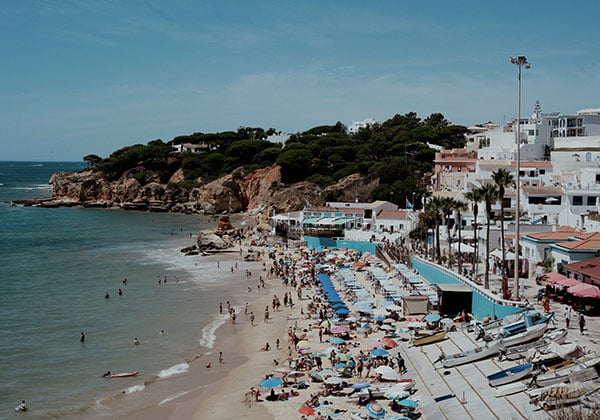
The Algarve
Consistently ranks as one of the best retirement destinations in the world by Forbes
English is widely spoken
300+ days of sunshine per year
Beautiful beaches, 39 golf courses, waterspots, and delicious gastronomy
In Portugal, you become a tax resident based on how much time you spend in the country or your ties to it. In most cases, you are considered a resident if you stay in Portugal for 183 days or more in a year, or if you have a habitual home there.
If you are a resident, Portugal taxes your worldwide income. If you are a non-resident, you pay tax only on income from Portugal. For retirees, this usually includes pensions, investments, and benefits from the US Social Security while living in Portugal.
Portugal uses progressive income tax rates from about 12.5 percent to 48 percent, depending on your income. Certain income, like capital gains or dividends, is taxed at flat rates.
The tax year lasts from 1 January to 31 December, and you often file your return by June 30 of the next year. When it comes to retiring in Portugal, taxes can be complex to manage, which is why we suggest you consult with a local tax advisor. To learn more about Portugal’s taxes for retirees, check our guide about taxes in Portugal.
Inheritance tax for retirees in Portugal
Portugal does not impose an inheritance tax on real estate. However, there is a 10 percent flat-rate stamp fee. Unless otherwise specified, spouses, descendants, and parents are not subject to this payment. The process of inheritance also involves a little administrative cost.
According to the Portuguese Civil Code, any succession process must follow the rules of the nation where the deceased person resided. US inheritance law will be in effect if you retire from the US to Portugal. If the other spouses are Portuguese permanent residents, Portuguese law may still be applicable if both spouses are foreign nationals.
This can be prevented by mentioning it in the will. Make sure you create a thorough will that a lawyer has approved. Having separate wills in Portugal and the place of origin may be even better for retirees from the US, UK, Australia, and Canada.
What is the healthcare system like when retiring in Portugal?
Portugal’s healthcare system has public and private medical facilities, both with excellent healthcare access. The National Health Service (NHS), or Serviço Nacional de Saúde, provides free healthcare with minimal out-of-pocket costs to children under 18 and to people over 65.
Americans retiring in Portugal will notice that medical services such as GP consultations, emergency care, and basic hospital treatments are free, while options like X-rays, scans, and other tests come with small additional fees. However, they remain drastically cheaper than in the United States.
Expats often choose private healthcare in Portugal due to its affordable costs, which vary from €30 ($34) and €60 ($68) every month for basic healthcare plans. Comprehensive medical insurance can cost more depending on the coverage, but it remains affordable.
Retirement in Portugal for US citizens feels very affordable when you look at the costs for doctor visits and dental care. A doctor’s visit in Portugal costs about €50 ($55), while in the United States it costs around €100 ($110). Dental cleaning is also cheaper in Portugal, costing about €25 ($30) compared to €115 ($125) in the USA.
Many expats retiring in Portugal opt for private insurance for other reasons as well, such as to reduce wait times, consult with more English-speaking doctors, and enjoy faster response times. However, keep in mind that rural areas often lack emergency care facilities or hospitals with extensive medical services. So, retirees should be aware of the nearest hospitals, local clinics, have emergency contacts at hand, and have a reliable transportation method, preferably a car.
Insurance for Retirees in Portugal
Retirees living in Portugal enjoy access to one of Europe’s most affordable and comprehensive insurance ecosystems. While healthcare is typically the first consideration, other types of coverage — from home to vehicle and life insurance — play an important role in financial planning and long-term security.
Home and property insurance
If you buy or rent in Portugal, home insurance (seguro de habitação) is strongly recommended — and mandatory if the property is mortgaged.
Two main types exist:
Basic coverage: fire, flood, and structural damage.
Comprehensive coverage: includes theft, natural disasters, liability, and damage to fixtures or contents.
Annual costs vary depending on property value and location, but typically range between €120 and €450 ($135 – $505) per year for standard coverage. Insurance companies also offer multi-risk policies (seguro multirriscos), which combine building, contents, and liability coverage in one package — especially popular among foreign homeowners.
Vehicle insurance
If you plan to drive in Portugal, motor insurance is compulsory. The minimum requirement is third-party liability coverage, which protects others in the event of an accident.
Comprehensive coverage (including theft, vandalism, and personal injury) is strongly advised, especially for imported or higher-value vehicles. Annual premiums depend on driver age, vehicle type, and driving history, but retirees can expect to pay €300 – €900 ($335 – $1,010) per year for full coverage.
Travel insurance
Although healthcare access is solid in Portugal, many retirees maintain travel insurance for trips abroad. These policies often cover:
Emergency medical care abroad
Trip cancellation or interruption
Lost luggage or personal belongings
Frequent travelers may benefit from multi-trip annual plans, typically costing €150 – €500 ($165 – $55) per year, depending on destination and age.
Life and funeral insurance
Life insurance (seguro de vida) is not mandatory but can be beneficial, particularly for retirees with dependents or property. It provides financial protection for spouses or family in the event of death and is often paired with a mortgage. Meanwhile, funeral insurance (seguro de funeral) is increasingly common in Portugal, covering funeral expenses and administrative arrangements. Policies are relatively inexpensive, with premiums as low as €10 – €25 ($11 – $28) per month.
What are the housing options when retiring in Portugal?
There are a variety of housing options in Portugal for retirees:
Modern apartments: You can purchase an apartment in major cities like Lisbon, Porto, or Faro. That way, all the attractions are within reach.
Houses: If you want a traditional lifestyle, a country home, also known as a quinta, is a great choice. You can find them in the outskirts, often in smaller towns and villages. However, if you prefer modern commodities, a townhouse with a garden, terrace, and a swimming pool can be a better alternative.
Gated communities: There are many retirement communities in Portugal, offering a variety of services such as independent living, memory care facilities, nursing homes, and continuing care communities.
Short-term rentals: If you want to explore the area first before you commit to it, you can live in a fully furnished holiday home. For more information, check our article on renting in Portugal.
Shared housing: If you are looking for the cheapest place to retire in Portugal, co-living spaces would be your best bet. Many expats choose to share a property with other retirees to reduce the costs and socialize. There are also homes for assisted living in Portugal, for a more personalized experience. For seniors seeking a premium experience, there are various luxury care homes in Portugal with state-of-the-art spas and wellness centers.
Check the latest trends for Portugal’s property market in our ultimate guide
Goldcrest is the first buyer’s agent in Portugal. We provide expert, impartial advice on real estate investments and how to buy property in Portugal. From scouting out the perfect property through to property acquisition, we have you covered throughout the process.
Unlike traditional real estate agents in Portugal who represent the seller, we are dedicated exclusively to protecting the buyer’s interests.
If you are looking to purchase property in Portugal, don’t hesitate to get in touch. Our team of skilled experts is available to solve all your real estate doubts, helping you with the property search and offering insightful expertise and strategic advice.
Why choose Goldcrest?
Local knowledge: With offices located across Portugal, our presence nationwide allows us to assist you personally across the country.
Independent service: As an independent buying agent, we do not represent any development or project. Our service is entirely tailored toward each individual client, providing you with everything you need to secure the perfect property at the best possible price.
Streamlined process: Our real estate agents speak English and Portuguese, and our service is completely focused on providing you with a hassle-free buying experience, saving you time. We can also help you buy property remotely.
Experienced team: Our expert real estate team has a vast local knowledge of the Portuguese property market. We have cutting-edge technology and metasearch tools at your disposal to provide full market coverage, ensuring the best investment choices and negotiated prices.
Network of partners: We have a close network of partners, including lawyers, property management services, builders, architects, designers, and landscape gardeners, again saving you time and hassle by providing you with trusted experts in their field of work.
Frequently Asked Questions about Retiring in Portugal
Is Portugal a good place to retire?
According to the Global Citizen Solutions Intelligence Unit, Portugal is the world’s best country for retirees, based on factors such as quality of life, safety, integration, and economics. All in all, the pros outweigh the cons, especially for retirees drawn to beautiful golden beaches, historic Portuguese culture, stunning landscapes, and a slower pace of life.
How to retire in Portugal as a foreigner?
To meet the basic requirements to retire in Portugal, you need a valid passport, proof of financial self-sufficiency, a clean criminal record, valid health insurance, and a fiscal address in Portugal.
How much do I need to retire in Portugal?
Portugal has a relatively affordable cost of living compared to much of Western Europe. Retired couples can live comfortably on about €1,335–€1,780 ($1,500–$2,000) per month in small towns and charming villages.
But, for major cities like Lisbon or Porto, couples typically need a budget of around €2,225–€2,670 ($2,500–$3,000), including rent. Of course, these are general estimates and can vary based on lifestyle choices.
Where is the best place to retire in Portugal?
For the best places to retire in Portugal consider Lisbon and Porto if you are looking for a good life in the city. Cascais is an excellent location a short 30-minute drive from Lisbon. Consider the Algarve region for a relaxed retirement with plenty of beaches and golf courses.
For historic flair, the towns of Braga, Guimaraes, and Ponte de Lima are for you, and the Silver Coast provide a more authentic side to Portugal, which is also worth exploring. The autonomous islands of Madeira and the Azores are some of Portugal’s coolest hotspots, for those seeking more peace and tranquility.
Is it easy to move to Portugal?
It is relatively easy to move to Portugal, one of the most affordable European countries. To retire abroad to Portugal as a non-EU national, you will need to apply for Portuguese residency and secure a valid residence permit. From the Portugal Golden Visa to the D7 Visa (Passive Income Visa), there are different options on the table to get a residence permit.
How much does it cost to retire in Portugal?
A family of four’s estimated monthly costs are €2,436 ($2,740) without rent, while a single person’s estimated monthly costs are €674 ($760) without rent. Note that how much you’ll need to live comfortably in Portugal strongly depends on your lifestyle.
What is the retirement age in Portugal?
For 2027, the Portugal retirement age is 66 years and 11 months.
Can a US citizen retire in Portugal?
Yes, retiring in Portugal as an American is certainly possible, but you will need to apply for Portuguese residency. Some good visa options to consider for retirees include the D7 Visa, D8 Visa, or the Portugal Golden Visa. The process is straightforward but may take some time.
What are the downsides of retiring in Portugal?
The downside of retiring to Portugal is lower salaries than in other European Union (EU) nations, the lack of central heating in many homes, and sometimes slow bureaucracy. If you know basic Portuguese, you can find it easier to integrate into Portuguese society.
What is the process of retirement in Portugal for EU citizens?
European Union (EU) citizens will be able to move to Portugal relatively easily. They will be able to establish residence in the country. After three months, they will need to secure a registration certificate at their local council.
Can you retire in Portugal from the UK?
Yes, Brits can retire to Portugal. But, since the UK is no longer part of the EU, you must apply for a visa if you plan to stay long-term, such as the D7 Visa, Golden Visa, or other residency permit options.
How can I get Portugal Retirement Visa?
You can get a D7 Visa, or Portugal Retirement Visa by meeting the following requirements:
Be a non-EU national
Earn a passive income of at least €920 per month (your income can be pension income, social security benefit, transferable equity, real estate, intellectual property, or financial equity)
Show proof of a place to live in Portugal
Be willing to reside for more than 183 consecutive days per calendar year in Portugal
Can I live in Portugal as a US citizen?
A US citizen can enter Portugal and remain for 90 days without a visa. For an American to live in Portugal, you need to apply for a visa, then apply for residency with the Portuguese government. Popular visa options for US citizens include the D2 Visa, D7 Visa, D8 Visa, and the Portugal Golden Visa.
Where do Americans retire in Portugal?
Most American citizens settle around the Algarve coastline, especially in Lagos, Faro, and Tavira. Those who prefer a better nightlife and business opportunities move to Lisbon and Porto. However, US retirees who want to save on costs often choose the Silver Coast.
Can American expats in Portugal obtain Portuguese citizenship?
Yes, dual citizenship is permitted between Portugal and the United States of America. You can only apply for permanent residence and citizenship after five years of legal residency. You must demonstrate that you speak a little Portuguese by passing an A2 Portuguese language test.
Can you retire in Portugal from Canada?
Yes, you can retire in Portugal from Canada by applying for Portuguese residency. Popular visa options for retirees include the D7 Visa and the Portugal Golden Visa.
Can you retire in Portugal from Australia?
Yes, you can retire in Portugal from Australia, you will just need to apply for Portuguese residency. Popular visa options for retirees include the D7 Visa and the Portugal Golden Visa.
Do I need to speak Portuguese when retiring in Portugal?
While learning basic Portuguese will undoubtedly come in handy when retiring in Portugal, especially for integrating into the culture of the country, a large portion of the Portuguese population speaks English very well and you will be able to get by without being fluent in the local language.
Are there family reunification benefits to retiring in Portugal?
Yes, retiring in Portugal offers family reunification benefits. As an EU citizen or resident, you can bring close family members, such as a spouse, children, or dependent relatives, to join you and live in Portugal.
What are the social security benefits when retiring in Portugal?
Social security benefits in Portugal include a contribution-based state pension. We recommend you reach out to a financial advisor to ensure you meet the requirements for this benefit.
Is it hard for an American to retire in Portugal?
Retiring in Portugal as an American is straightforward, mainly via the D7 Visa. This requires demonstrating passive income and a clean criminal record. After obtaining a residence permit, you can apply for permanent residency and citizenship provided you meet the requirements.
Does Portugal tax US retirement income?
If you’re a tax resident, meaning that you spend more than 183 days in Portugal, you will be taxed on your worldwide income. However, Portugal does have Double Tax Agreements (DTAs) with both many countries, making sure your income is not taxed twice.
Related Articles
2030 World Cup Comes to Portugal: What it Means for Property Buyers
We use cookies to ensure that we give you the best experience on our website. Our Terms and Conditions
Functional
Always active
The technical storage or access is strictly necessary for the legitimate purpose of enabling the use of a specific service explicitly requested by the subscriber or user, or for the sole purpose of carrying out the transmission of a communication over an electronic communications network.
Preferences
The technical storage or access is necessary for the legitimate purpose of storing preferences that are not requested by the subscriber or user.
Statistics
The technical storage or access that is used exclusively for statistical purposes.The technical storage or access that is used exclusively for anonymous statistical purposes. Without a subpoena, voluntary compliance on the part of your Internet Service Provider, or additional records from a third party, information stored or retrieved for this purpose alone cannot usually be used to identify you.
Marketing
The technical storage or access is required to create user profiles to send advertising, or to track the user on a website or across several websites for similar marketing purposes.








 Portugal is one of the easiest places to get residency for Americans retiring in Portugal and other non-EU nationals.





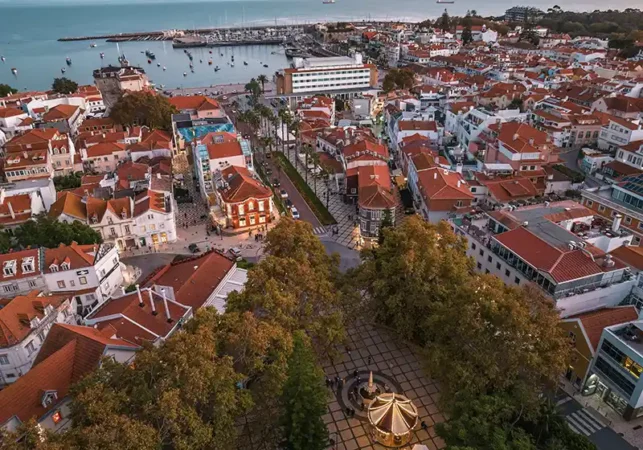 Sophisticated coastal town strategically located just 30 minutes from Lisbon, combining beautiful beaches with city convenience