Home » Real Estate » Land for Sale Lisbon, Portugal: Guide to Zoning, Permits & Costs
Updated: July 30, 2026
Looking for land for sale in Lisbon, Portugal? Whether you are interested in urban, rustic, or industrial land, it can feel like searching for a needle in a haystack. Land is scarce in the city itself and the wider metropolitan area due to high demand and limited supply.
A buyer’s agent, like Goldcrest, can source any land plot for sale in Lisbon, so you can use it to build your dream home or successful business. From the construction phase to the architectural design, purchasing land gives you full control over the layout, materials, and energy efficiency.
In this guide, we will cover the documentation, zoning regulations, and taxes that come with buying land in Lisbon, Portugal.
Foreigners can purchase land in Lisbon without restrictions. The process is accessible and requires a Portuguese tax number (NIF), which is essential for any fiscal activity, such as opening a local bank account, buying real estate, or setting up utilities.
According to Jornal Económico, Portugal has over 27,000 urban plots for sale, including about 4,137 in Lisbon. But high-quality development land is scarce, especially near major residential and tourist areas.
The Portugal property market continues to grow, with Q3 2025 median house prices up 16.1% year-on-year to €2,111/m² nationally, while Lisbon leads at €5,000/m², based on Statistics Portugal (INE).
As of 2026, the average asking price for land plots in Lisbon is around €2,511 /m². But the total cost varies based on the type of land, location, and size.
Can foreigners buy land in Lisbon?
Portugal allows foreign nationals from anywhere in the world to buy property in Lisbon. You don’t need a Portuguese residency or citizenship to own land, which means there are no restrictions on foreign ownership.
You can buy land anywhere in Portugal as a foreigner, but you must have a Portuguese tax number (NIF). You will use the NIF for every fiscal transaction, including paying taxes, opening a local bank account, and purchasing land.
Exploring Land for Sale in Lisbon, Portugal
According to the Journal Económico, there are over 27,000 urban plots for sale in Portugal, with around 4,137 urban land plots in the Lisbon District. Although the numbers can change, there is a shortage of high-quality development land, especially near major residential and tourist centers such as Lisbon and the Algarve.
The Portugal property market is steadily increasing. Based on Statistics Portugal (INE), the median house price rose 16.1 percent in Q3 2025 than the same period the year prior. The median national house price was €2,111 per square meter. However, the municipality of Lisbon recorded the highest rates at €5,000 per square meter.
Despite the surge in prices, Lisbon real estate investments are more affordable than in many Western European countries and the United States. The Lisbon land area available for purchase is mostly situated outside the historic center in suburban and peri-urban areas.
What types of land for sale in Lisbon are available?
There are different types of land for sale in Portugal. This includes residential, commercial, and agricultural land.
Residential land for sale in Lisbon
Residential land is urban land (terreno urbano), which means you can use the land to build a house, villa, or apartment. In the Lisbon area, buying land for a residential property, even with the construction costs, usually works out cheaper than buying a new build.
Commercial land for sale in Lisbon
From retail centers to hospitality ventures, commercial land (terreno para comércio) can be a good investment. It can create employment opportunities for locals and instigate significant development in areas that may have been neglected.
Agricultural land for sale in Lisbon
Agricultural land (terreno agrícola) is for farming, vineyards, or orchards. This type of land can be found in fertile plains like the Ribatejo and the Tagus River valley. It can be perfect for those who want to grow their own fruits, vegetables, cereals, and legumes.
Some farm land for sale in Lisbon’s periphery, such as Sintra, Colares, and Setúbal Peninsula, is used for producing wines. You can find many vineyards for sale in Portugal in hilly or fertile areas.
The agricultural land for sale in Lisbon is usually not zoned for residential construction. However, you may be able to build agricultural structures, such as farmhouses, greenhouses, or storage buildings.
Rustic land for sale in Lisbon
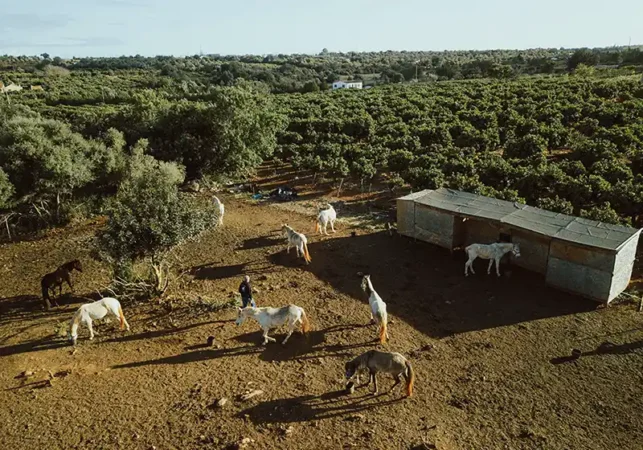
Rustic land (terreno rústico) is rural land that is not immediately buildable. Its main purpose is forestry, livestock grazing, or conservation use.
Rural land for sale in Lisbon can be found in the peripheral areas of the wider metropolitan region. However, building on rustic land is restricted, which means you cannot build a house or business without rezoning.
Cost of Land in Lisbon
The cost of land for sale in Lisbon varies by location, size, and development potential. As of 2026, smaller urban plots, under 800 square meters, can cost €500,000. Mid-sized lands and those with approved development projects can reach €2 million to €4 million.
The cheapest land plots for sale in the Lisbon area are further away from tourist areas and the city center. Santa Clara and Penha de França are among the more affordable districts per square metre, but they are not among the absolute lowest land prices nationwide.
Premium plots in popular Lisbon neighborhoods such as Avenidas Novas, Parque das Nações, Estrela, Belém, or Alcântara can exceed €6 million, with larger land sometimes listed above €10 million. But bear in mind that the average asking prices can change with zoning regulations, building permits, and demand.
The table below provides examples of the general asking prices for land in Lisbon, Portugal, for February 2026:
Location
Price (€)
Size (m²)
Type of land
São Vicente (Rua C)
585,000
713
Urban land, developed plot
Santa Clara (Rua João Amaral)
2,600,000
2,320
Buildable land with approved project
Avenida do Restelo (Belém)
2,995,000
1,379
Urban land with project for villas
Rua João Amaral, Santa Clara
2,400,000
2,240
Land with approved project
Ajuda (Casalinho da Ajuda)
3,000,000
2,000
Rustic land
Alcântara (Av. de Ceuta)
6,490,000
6,121
Large land parcel
Ajuda (Travessa Armador)
2,500,000
997
Urban land with approved project
Penha de França
2,750,000
450
Land with approved project
Belém (Santo António a Belém)
750,000
273
Small urban plot
Lisbon Land for Sale: What You Need to Know
Buying land in Portugal can be an exciting opportunity, whether you’re looking to build a private home, a commercial project, or invest for the future. However, navigating the property regulations and local planning rules requires careful research to avoid costly mistakes. Here’s what you should know.
Rustic vs urban and the “new land law”
When buying land in Lisbon, you will often come across two categories: urban (urbano) and rustic (rústico). Urban land is for building properties, and it often comes with access to roads and utilities. Rustic land is for agriculture, forestry, or conservation, and building is highly restricted.
The Portuguese government published Decree-Law No. 117/2024 on 30 December 2024. This new law changed the existing land-use and planning code known as Regime Jurídico dos Instrumentos de Gestão Territorial (RJIGT). With it, municipalities can more easily change some rural land into urban land, so you can use it to build property. The purpose of this new land law was to ease housing shortages.
Zoning and PDM
The Plano Diretor Municipal (PDM) zoning rules for Lisbon land construction include:
Land classification: Each plot of land can be urban, rustic, rural, or protected. For example, protected areas in Portugal fall into Reserva Ecológica Nacional (REN) or Reserva Agrícola Nacional (RAN). The PDM decides which types of construction and activities you can do on the land.
Permitted use: The PDM indicates what you can use the plot for, such as residential, commercial, tourism, or industrial properties.
Building parameters: This includes maximum building area, height, number of floors, and coverage ratios.
Approval process: Landowners cannot reclassify land on their own. You can ask the local municipality (Câmara Municipal) to convert the rustic land into urban land by requesting a PDM amendment. You will also need land registry documents, planning studies, proof of zoning, and additional documents.
Buildability and licensing risk
Even if the land is urban, you must hire an architect to carry out a planning analysis and confirm what the council will actually approve, since the advertised buildable area is not a guaranteed legal right. Lisbon’s licensing (licenciamento) process is often slow and paperwork-heavy.
Although Decree-Law 10/2024 introduced time limits and tacit approval, it doesn’t mean you will always get approved. Opt for a plot that already has an approved architectural project or volumetric study. This reduces the risk and saves you time.
To build legally, you must obtain a building permit (Licença de Construção) from the local municipality. If you are planning to build a property, make sure you get buildable land with approved projects in Lisbon.
An approved project already has a construction license or a pending building permit, and is faster to build. However, the property must be constructed exactly as approved.
Land without approval takes longer to build. You must first request a building permit, and after construction, you need a habitation license (Licença de Utilização).
Land taxes in Lisbon
When buying land in Portugal, property owners pay one-time and yearly taxes. The one-time taxes include the Property Transfer Tax (IMT) and Stamp Duty (Imposto de Selo). The yearly taxes include the Municipal Property Tax (IMI).
Although the rates vary depending on the land type, location, and value, the IMT rate is usually lower for standard urban land, while the IMT is higher for luxury urban plots. For more details, check our guide on property taxes in Portugal.
Step-by-Step Guide to Buying Land in Lisbon
The process for buying land in Portugal is relatively straightforward for foreigners. You will need a NIF number (Portuguese tax identification number) and, ideally, a Portuguese bank account to save on transaction costs. If you are a non-EU citizen, you will need to have a fiscal representative to get your Portugal NIF number.
Here is a step-by-step process for buying land in Lisbon, Portugal.
Step 1: Financing
The first step is to consider financing and, if needed, contact a mortgage broker to determine which type of mortgage in Portugal you will need.
There are more than 15 banks in the country that provide mortgages to foreign buyers, but make sure you take the time to research and understand which is the best option for your personal situation.
Step 2: Finding land that meets your requirements
After you determine your budget, it can be easier to filter properties and find land that fits your needs. Research the market to get a rough picture of what you can expect to purchase and ballpark prices.
We highly suggest you consult with a buyer’s agent or a real estate agent in Lisbon. Local experts can pinpoint specific locations. Since Portugal doesn’t have a single database for all real estate listings, working with local experts can help you stay up to date on the latest trends and land prices.
Step 3: Negotiating
Once you’ve found the perfect plot, it’s time to negotiate. Our buyer’s agents at Goldcrest can negotiate prices on your behalf, which gives you a strategic advantage if you are looking to buy cheap land for sale in Lisbon, Portugal.
Step 4: Reservation Agreement and Promissory Contract
The next step is often to sign a Reservation Agreement, which basically means that the property is taken off the market while you make your final decision. Usually, a fee of €5,000- €15,000 is paid, although this is usually deducted from the property price.
Following this, the Promissory Contract or Contrato Promessa de Compra e Venda (CPCV) is signed. The CPCV formalizes the transaction, including the property purchase price, payment schedule, and any conditions that must be met before the final deed signing. We recommend that the CPCV be signed in front of a notary.
Step 5: Final deed signing
The final part of your property-buying journey is to sign the deed, known as the Escritura, and make the remaining payment. Signing the Escritura transfers ownership of the property to you and is done in the presence of a notary.
Hidden Costs and Timelines for Land Purchase in Lisbon
Other than the price of the land and construction costs, you should budget for hidden costs. These include:
Notary fees: €500 – €1,000
Land registry fees: €200 – €250
Legal fees: €2,000 – €5,000
Architectural and engineering fees: €10,000 – €20,000
Utility connection fees: €1,500 – €5,000
Reclassification costs (if applicable): €5,000+
Goldcrest: How We Can Help You
Goldcrest is the first buyer’s agent in Portugal. We provide expert, impartial advice on real estate investments and how to buy property in Portugal. From scouting out the perfect property through to property acquisition, we have you covered throughout the process.
Unlike traditional real estate agents in Portugal who represent the seller, we are dedicated exclusively to protecting the buyer’s interests.
If you are looking to purchase property in Portugal, don’t hesitate to get in touch. Our team of skilled experts is available to solve all your real estate doubts, helping you with the property search and offering insightful expertise and strategic advice.
Why choose Goldcrest?
Local knowledge: With offices located across Portugal, our presence nationwide allows us to assist you personally across the country.
Independent service: As an independent buying agent, we do not represent any development or project. Our service is entirely tailored toward each individual client, providing you with everything you need to secure the perfect property at the best possible price.
Streamlined process: Our real estate agents speak English and Portuguese, and our service is completely focused on providing you with a hassle-free buying experience, saving you time. We can also help you buy property remotely.
Experienced team: Our expert real estate team has a vast local knowledge of the Portuguese property market. We have cutting-edge technology and metasearch tools at your disposal to provide full market coverage, ensuring the best investment choices and negotiated prices.
Network of partners: We have a close network of partners, including lawyers, property management services, builders, architects, designers, and landscape gardeners, again saving you time and hassle by providing you with trusted experts in their field of work.
Frequently Asked Questions about Land for Sale, Lisbon, Portugal
Is buying land worth it in Lisbon for 2026?
Purchasing land for sale in Lisbon can be worthwhile if you want full customization options and to choose financially efficient ways to build your dream home in Portugal.
What are current land taxes and fees for buying in Lisbon?
When buying land in Lisbon, you pay IMT (property transfer tax) at different rates, stamp duty at 0.8 percent of the purchase price, plus notary and land registry fees. The annual IMI property tax comes after purchase.
How to check if you can reclassify rustic land in Lisbon?
To check if you can reclassify a rustic land in Lisbon, visit the local city hall, check the PDM plan, or consult with the land registry. A buyer’s agent or a real estate agent in Lisbon can guide you through the reclassification process.
How to get building permits and licenses for Lisbon land?
To build on land in Lisbon, hire an architect to prepare your project, submit it to the city hall for approval, and obtain the construction permit. Follow zoning rules, pass municipal inspections, and obtain the habitation license to occupy the building legally.
What documents do I need to buy land in Lisbon, Portugal?
To complete the purchase you will need:
Land Registry Certificate
Municipal Master Plan (PDM)
Tax registration (Caderneta Predial)
Habitation license (if necessary)
Subdivision permit (if necessary)
Construction license (if necessary)
How to analyze the terrain before buying land in Lisbon, Portugal?
Check the land for soil quality, composition, sun exposure, and wind orientation. Evaluate whether the land is flat, hilly, or sloped. Don’t forget to analyze surrounding factors, such as access to roads and utilities.
How to check if you can build on land in Lisbon, Portugal?
Before buying land, check if construction is allowed, confirm the plot isn’t in an illegal urban area, and verify it belongs to an approved subdivision (loteamento) with a valid permit (alvará). Then check for local restrictions in the Municipal Master Plan (PDM) to make sure you can build on the land.
Related Articles
Testaments in Portugal: Why They Matter for People Who Own Assets
We use cookies to ensure that we give you the best experience on our website. Our Terms and Conditions
Functional
Always active
The technical storage or access is strictly necessary for the legitimate purpose of enabling the use of a specific service explicitly requested by the subscriber or user, or for the sole purpose of carrying out the transmission of a communication over an electronic communications network.
Preferences
The technical storage or access is necessary for the legitimate purpose of storing preferences that are not requested by the subscriber or user.
Statistics
The technical storage or access that is used exclusively for statistical purposes.The technical storage or access that is used exclusively for anonymous statistical purposes. Without a subpoena, voluntary compliance on the part of your Internet Service Provider, or additional records from a third party, information stored or retrieved for this purpose alone cannot usually be used to identify you.
Marketing
The technical storage or access is required to create user profiles to send advertising, or to track the user on a website or across several websites for similar marketing purposes.




 When buying land in Lisbon, you will often come across two categories: urban (urbano) and rustic (rústico). Urban land is for building properties, and it often comes with access to roads and utilities. Rustic land is for agriculture, forestry, or conservation, and building is highly restricted.