Buying Property in Lisbon as a Foreigner: 2026 Guide for Smart Buyers
Artur Saraiva |Global Residency Strategy Director|
Updated: November 24, 2026
Home » Real Estate » Buying Property in Lisbon as a Foreigner: 2026 Guide for Smart Buyers
Updated: November 24, 2026
With stable long-term demand, a strong business landscape, and no restrictions on ownership, Lisbon remains one of Europe’s most compelling capitals for foreign buyers purchasing real estate.
Foreigners can buy property in Lisbon without Portuguese citizenship or residence. The buying process has a predictable order: A Portuguese tax number (NIF), due diligence on a property (ideally with a lawyer of your own), a Promissory Contract with a deposit, and finalizing the deed and registration.
What’s changed in 2026 is the cost. Since Decree-Law 97/2026, non-residents who buy urban residential property in Portugal pay a new flat 7.5% IMT (Property Transfer Tax), plus the 0.8% Stamp Duty tax.
As buyer’s agents in Portugal, Goldcrest put together a guide to buying property in Lisbon, from the latest changes to the average property prices, legal requirements, and the best neighborhoods for foreign buyers.
Key Takeaways: Buying Property in Lisbon, Portugal
You can buy a house in Lisbon as a foreigner without a visa, residency, or nationality-based restrictions.
Obtaining a Portuguese tax number (NIF) is the first legal requirement for all foreign buyers.
The average asking price is €5,045/m² in the Lisbon Metropolitan Area and €7,086 /m² in Lisbon itself, based on Confidencial Imobiliário (Q4 2025).
The buying process takes 1-4 months, according to average timelines.
The Promissory Contract (CPCV) is a legally binding document that reserves the property with a 10-20% deposit on average.
Buying property doesn't give you residency in Lisbon; the Golden Visa real estate investment route ended on October 2023.
Buyers should set aside 6-10% for additional costs on top of the purchase price.
Can foreigners buy property in Lisbon?
Yes, foreigners can buy property in Lisbon, Portugal, without restrictions based on their nationality.
Portugal has no limits on real estate ownership for EU and non-EU citizens. Non-residents, such as Britons, Indians, Brazilians, Canadians, or any other foreign nationals, have the same legal right to buy, own, resell, and rent out a Lisbon property as a Portuguese citizen.
You don’t need a visa, legal address in Portugal, or a residency permit to own property there. The buying process is relatively simple, straightforward, and transparent for everyone involved, considering you’ve done proper due diligence.
The first step to buying property in Lisbon for foreigners is to obtain a Portuguese tax number (NIF – Número de Identificação Fiscal). The NIF is a legal requirement for all expats purchasing any type of Lisbon real estate.
Most non-residents get their NIF remotely through a fiscal representative in Portugal. However, whether you need fiscal representation depends on where you live and whether you have fiscal ties to Portugal, such as owning property, a car, or other taxable assets there.
Can Americans buy property in Lisbon?
Yes, US citizens can buy property in Lisbon without nationality-based restrictions. You don’t need a special visa, permit, or Portuguese residency to become a real estate owner.
However, owning a house in Lisbon will not give you the right to live in Portugal or automatically make you a tax resident. American citizens who are not Portuguese residents can stay in Portugal for up to 90 days in any 180-day period.
After buying property in Lisbon as an American, to become a Portuguese tax resident, you need to spend over 183 days in Portugal (consecutive or not) in a 12-month period, or maintain a permanent, habitual residence there.
The Portugal Golden Visa real estate route closed in October 2023, and although the RBI program is still active, you can’t buy a property in Lisbon and use it to move to Portugalpermanently. To obtain a residency permit, you can choose to apply for one of the long-term Portugal visas.
Tip: US citizens or Green Card holders who own property in Lisbon may need to file a US tax return. When it comes to Foreign Tax Credit (FTC), Social Security distributions, treatment of 401(k), and IRAs, it’s best to consult with a local tax advisor.
What’s the average cost of real estate in Lisbon?
The cost of buying property in Lisbon is different for every type of property, the location you choose, and what you intend to do with it.
The average cost of residential real estate in Lisbon municipality is €5,299/m² and €4,030/m² in Greater Lisbon in Q2 2026, based on median selling prices from Statistics Portugal (INE – National Institute of Statistics), published on October 23, 2026.
Lisbon has some of the highest house prices in Portugal, considering the national median sale price is €2,445/m².
However, to get a realistic picture of Lisbon’s property market, it is important to understand the difference between average asking prices and sale prices.The asking price shows what sellers hope to get, and a prospective buyer can see it on Lisbon property listings, while the median sale price indicates what the property actually sold for in a particular period.
The average asking price for Lisbon property for sale is €5,045/m² in the Lisbon Metropolitan Area and €7,086/m² in Lisbon itself, according to the Q4 2025 data we extracted fromConfidencial Imobiliário. That means you have plenty of room for negotiation.
Here is a complete list of the average asking prices when buying real estate in Lisbon, based on the municipality:
Lisbon municipality
Average price /m²
Cascais
€7,327
Lisbon
€7,086
Loures
€3,697
Mafra
€3,570
Oeiras
€5,338
Sintra
€3,438
Vila Franca de Xira
€2,986
Amadora
€3,389
Odivelas
€3,431
Alcochete
€4,023
Almada
€4,011
Barreiro
€2,747
Moita
€2,444
Montijo
€2,931
Palmela
€2,755
Seixal
€3,319
Sesimbra
€4,338
Setúbal
€3,206
Source: ConfidencialImobiliário, Q4 2025 Data
Here are the average asking prices for houses for sale in Lisbon, Portugal, in popular neighborhoods for foreign buyers:
Lisbon municipality
Average price /m²
Ajuda
€5,564
Alcântara
€6,966
Beato
€5,110
Benfica
€5,387
Campolide
€7,186
Carnide
€5,014
Lumiar
€6,432
Marvila
€7,432
Olivais
€5,111
S Domingos de Benfica
€5,968
Alvalade
€6,926
Areeiro
€7,002
Arroios
€6,552
Avenidas Novas
€9,397
Belém
€7,076
Campo de Ourique
€7,122
Estrela
€7,853
Misericórdia
€7,937
Parque das Nações
€8,120
Penha de França
€5,096
Sta Clara
€4,495
Sta Maria Maior
€7,458
Sto António
€8,817
São Vicente
€6,664
Source:Confidencial Imobiliário, Data Q4 2025
How to Buy Property in Lisbon: 8 Steps
The buying process in Lisbon can take 1-4 months, based on average estimates, from the time you make an offer to signing the final deed of sale. However, every case is different, and some can take longer.
For detailed step-by-step instructions, follow this Lisbonproperty buying guide:
Get your NIF and open a bank account: Receive a Portuguese NIF number, so you can perform all fiscal activities in the country, including buying property. Open a local bank account to save on foreign transfer fees.
Secure financing: Check if you have the budget to finance the final purchase price; if not, you can apply for a mortgage, compare the options, and calculate your borrowing capacity.
Research and view properties: Compare the prices in different areas and see which one matches your lifestyle. Visit the real estate in person, or schedule an online property viewing with the seller.
Make an offer and negotiate: Check the housing valuations in Lisbon and negotiate prices with the seller, or have a buyer’s agent negotiate on your behalf.
Perform due diligence: Have a property lawyer perform due diligence on the real estate by resolving any legal issues, hidden debts, or lack of licenses on your behalf.
Sign the Reservation Agreement and Promissory Contract (CPCV): Pay a small reservation fee to remove the property from the market, then sign the CPCV with a 10% to 20% deposit.
Sign the Escritura (final deed of sale): Finalize the transfer of ownership with the property deed about 2 to 12 weeks after signing the Promissory Contract. You sign the final deed of sale before a Notary, where you pay the remaining balance.
Register the property: The Notary registers you as the owner of the property at the Land Registry, finalizing the legal ownership transfer.
Legal Requirements and Property Due Diligence
Buying property in Lisbon is open to all foreigners regardless of their nationality. But the purchasing process requires strict administrative and legal requirements, such as obtaining a Portuguese tax number (NIF), providing the necessary documents, and valid IDs.
It is not legally mandatory to open a Portuguese bank account, yet it is highly recommended so expats can reduce transaction costs and pay the deposit, purchase price, or apply for financing.
NIFand fiscal representation
Obtaining a NIF is one of the main legal requirements for buying property in Lisbon, Portugal, as a foreigner, as it is mandatory.
If you don’t reside in Portugal and have fiscal activities in the country, you can appoint a fiscal representative who has Portuguese residency.
You can apply for a NIF personally at the Portuguese tax office (Finanças) and Citizens’ Shop (Loja do Cidadão) or online, often with a fiscal representative by your side, such as Global Citizen Solutions.
You can receive your NIF the same day or within 5-10 business days with online applications, based on average timelines.
Required documents for property due diligence
During the due diligence process, the buyer assesses the physical, legal, and financial condition of the Lisbon real estate for sale before they make the purchase. You can use it as a legal audit to avoid making a bad investment.
Although it is not legally mandatory, an independent real estate lawyer in Lisbon can perform legal due diligence. They can flag any hidden debts, contract issues, ownership complications, or building restrictions.
The best property lawyer is licensed with the Portuguese Bar Association (Ordem dos Advogados). At this stage, both the seller and the buyer provide a series of documents.
Buyer’s documents may include:
Valid ID or passport
Portuguese NIF
Power of Attorney (if applicable)
Proof of address
Property Transfer Tax (IMT) receipt
Seller’s documents may include:
Property Tax Record (Caderneta Predial Urbana)
Land Registry Certificate (Certidão Permanente do Registo Predial or Certidão Permanente)
Technical Housing File (Ficha Técnica da Habitação), mainly for residential properties built or renovated after 2004
Habitation License (Licença de Utilização), for urban properties built after 1951
Note: Both the buyer and the seller are equally responsible for signing the Promissory Contract or CPCV (Contrato Promessa de Compra e Venda) and the final deed of sale (Escritura Pública de Compra e Venda), also known as a property deed or public deed.
For more details on what the documents are used for and how they affect each stage of the due diligence process, read our ultimate guide to property documentation in Portugal.
Buying an Apartment or Condo in Lisbon: What Should You Check
You can buy an apartment in Lisbon as an expat without restrictions. Apartments (apartamentos) are the most common type of housing in major cities.
There are a variety of options, from compact studios (T0), one-bedroom (T1), and two-bedroom (T2) units in the city center to spacious living areas in three-bedroom (T3) and four-bedroom (T4) flats, often in the suburbs.From developments in renovated historic buildings to new apartments in Lisbon’s prime areas with contemporary and luxury finishes, there is a selection of properties for every buyer.
However, before buying an apartment in Lisbon, we suggest you check the condition of the unit and the building itself by requesting:
Condominium fees (quotas de condomínio): These are regular payments a property owner makes for a shared development or a building. The fees are pooled together from lift maintenance, cleaning, building insurance, administrator fees, reserve funds, or other expenses. For more details on how each apartment’s ownership share (permilagem) is calculated, see Article 1424 of the Portuguese Civil Code.
Common reserve fund (undo comum de reserva): This fund is mandatory in every condominium and is used to pay the upkeep of the development. Each owner covers at least 10% of the share of the condominium’s other expenses, the owner’s meeting manages it, and the money must be held in a bank, based on Article 4 of Decree-Law 268/94. In other words, you can use it to check the building’s savings for the work that needs to be done sooner or later.
Approved or upcoming building works: Ask the seller to provide condominium meeting minutes (atas de condomínio) from the last 2-3 years. Look for any approved facade renovations, roof repairs, lift replacements, structural damage, or electrical work before you buy it.
Find out the best areas to buy a luxury apartment in Lisbon
Buying Property in Lisbon: Taxes and Additional Costs
Additional expenses add an extra 6-10% to the costs of buying property in Lisbon. These are legal fees, Notary fees, registration costs, and property taxes in Portugal. They will all affect your total purchase price.
One-time property taxes
IMT (Property Transfer Tax): Also known as Imposto Municipal sobre a Transmissão, it is based on the purchase price or the property’s tax value (VPT). The rates usually vary from 1 to 8 percent and depend on location, intended use, property value, and property type. That being said, a new 7.5% IMT tax rate was introduced for non-residents buying urban residential properties in Portugal, with some applicable exceptions, according to Decree-Law No. 97/2026.
Stamp Duty (Imposto de Selo): There is a fixed rate of 0.8 percent of the property’s purchase price.
One-time property purchase taxes: €300,000 example
Here is a hypothetical scenario of how the 7.5% IMT tax increase in Portugal could potentially look like for a foreigner buying a condo in Lisbon for €300,000:
One-time purchase tax
Rate
Calculation
Amount
Property Transfer Tax (IMT)
7.5%
€300,000 × 7.5%
€22,500
Stamp Duty tax
0.8%
€300,000 × 0.8%
€2,400
Total
8.3%
€24,900
Annual property taxes
IMI (Annual Municipal Property Tax): Also known as Imposto Municipal Sobre Imóveis, this ongoing tax is set by the Tax Authority (Finanças) and is based on the taxable property value (VPT). Rates often vary; urban properties can reach as high as 0.5 percent in certain circumstances, while rural properties typically have a rate of 0.8 percent.
AIMI (Additional Municipal Tax): This is an extra tax only applied to owners whose total share of Portuguese property (VPT) exceeds €600,000. In Portuguese, it is called Adicional ao Imposto Municipal Sobre Imóveis.
Note: If you earn rental income from Lisbon apartments, then you are subject to rental income tax. But if you decide to sell the property, then you must pay capital gains tax in Portugal on the profit you earn.
Additional costs
Notary fees: €500 to €1,000
Legal fees: €2,000 to €5,000
Land registry fees: €225 to €250
Where to buy property in Lisbon?
There are many Lisbon neighborhoods to choose from, each with its unique features, lifestyle, and local attractions.
When researching where to buy property in Lisbon as an investor, you need to consider the type of lifestyle you prefer, capital appreciation, or the tenant you hope to attract if you were to rent out your property. Of course, every area in Lisbon has a different lifestyle value, property prices, and rental yields.
For example, families and retirees often prefer the suburbs like Loures and Carnide, and entrepreneurs often gravitate toward central Lisbon, especially in Chiado and Baixa. Students, on the other hand, prefer a property in Entrecampos or Campolide because they are near the University of Lisbon.
Below, we will cover some of the best areas to live in Lisbon for foreign buyers and the average asking prices from Q4 2025 data we extracted from Confidencial Imobiliário.
Graça
Graça is a popular neighborhood for buying property in Lisbon, as it attracts tourists, entrepreneurs, and young professionals.
Graça is a central downtown area, situated on one of Lisbon’s seven hills, and provides stunning panoramic viewpoints (miradouros) over the city. The median price for properties for sale in Graça, Lisbon, is €6,664 per square meter.
There are various types of properties for sale in Lisbon, from renovated apartments, small studios, townhouses, and refurbished projects, to name a few.
The rental yields in Graça are stable because this neighborhood is part of Lisbon’s central areas. However, properties in Graça and other central regions, such as Bairro Alto and Alfama, have restrictions for new short-term rentals (Alojamento Local or AL) due to oversaturation.
As a result, Graça can be a better alternative for foreign buyers looking to invest in long-term rentals in Lisbon or non-rental property investments.
Chiado
Chiado is a central district in Lisbon that stands out with its traditional cafés, bookstores, art shops, and concept stores.
For investors, Chiado is the heart of the city with its bohemian vibe, open-air ruins of the Carmo Convent, and elegant architecture. This area was restored after the devastating fire in 1988, under the direction of Pritzker-winning architect Álvaro Siza Vieira.
The average property for sale in Chiado, Lisbon, costs €7,458 per square meter. Today, the beautiful pastel-colored, 18th-century Pombaline buildings attract international investors, long-term expats, and families.
Príncipe Real
Príncipe Real is Lisbon’s trendiest neighborhood with its lively nightlife, boutique shopping, iconic garden, and 19th-century palaces.
This residential neighborhood is one of the most sought-after areas for luxury real estate in Lisbon.
Filled with grand mansions, trendy restaurants, and Moorish kiosks, it is no wonder that many foreigners buying property in Lisbon, Portugal, choose to make Príncipe Real their new home.
The median property for sale in Príncipe Real, Lisbon, is €7,937 per square meter.
Avenida da Liberdade
Avenida da Liberdade is Lisbon’s most luxurious boulevard, built in the 19th century and known as the city’s main shopping street.
Filled with expensive restaurants, trendy bars, and luxury brands, most of which sit behind art-nouveau façades, the area attracts luxury buyers and affluent expats.
For investors, buying property in Lisbon’s Avenida da Liberdade means high capital appreciation, steady rental income, and strong demand from tourists.
The median property for sale in Avenida da Liberdade, Lisbon, costs €8,817 per square meter.
Bairro Alto
Bairro Alto is one of the top Lisbon neighborhoods for its active nightlife, bars, clubs, and different restaurants.
Property investors are drawn to Bairro Alto when they want their Lisbon property to attract young professionals or students.
Located on a hill just west of Baixa (downtown Lisbon), Bairro Alto is an old “upper” district in the Misericórdia parish.
When it comes to the average expenses, properties for sale in Barrio Alto, Lisbon, cost €7,937 per square meter.
But, similar to the rest of central Lisbon, AL licenses are restricted, which is why many investors purchase properties here to use them as long-term rentals or simply prefer a strategic location to live.
Estrela
Estrela is one of the most elegant and residential neighborhoods in Lisbon. Famous for its green spaces, luxury real estate, and historic landmarks, it attracts many international investors, families, and luxury property buyers.
One of the key selling points in Estrela is the Basilica da Estrela, which is an 18th-century Baroque church. Pair that with the family-friendly cafés, playgrounds, and the Jardim da Estrela (Estrela Park), and it is easy to see why many foreigners buy property in this part of Lisbon.
The average property for sale in Estrela, Lisbon, costs €7,853 per square meter. Residential rental yields are stable at 4.5 percent, making it a great way to boost your rental income.
Lapa
Lapa is another neighborhood in central Lisbon popular with investors, young professionals, and families.
This area offers a quiet, exclusive, and residential atmosphere. Although it is not a major tourist destination, here, the luxury real estate market in Lisbon is thriving. Lapa attracts long-term expats, wealthy families, and diplomats.
The average property for sale in Lapa, Lisbon, costs €7,853 per square meter. Since it is part of the Estrela parish, the rental yields are stable and equally profitable.
Alfama
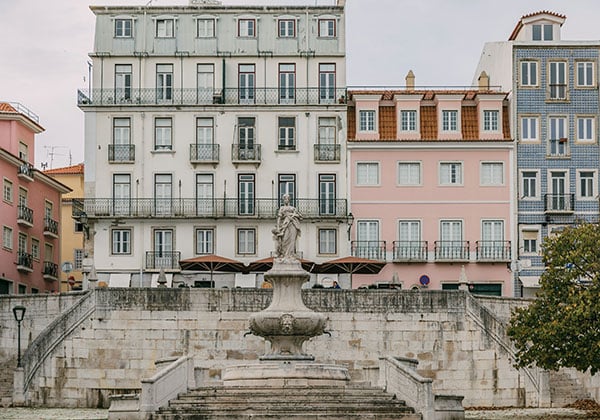
Alfama is one of the oldest and most iconic neighborhoods in Lisbon. Famous for its narrow cobbled streets, traditional architecture, and Fado houses, to name a few.
Foreign buyers are drawn to the Castelo de São Jorge (São Jorge Castle) with its stunning panoramic views over the Tagus River and the rest of Lisbon.
Alfama is a more traditional neighborhood with small cafés and local shops tucked into corners. The average property for sale in Alfama, Lisbon, is €7,458 per square meter, where rental yields can reach 5.1 percent.
This is an appealing location for investors targeting holiday rentals; however, new AL licenses are limited, so many international buyers invest in long-term rentals instead.
Quick facts: Best areas to buy property in Lisbon based on buyer’s goals
Buyer goal
Areas in Lisbon
Market status
Investment potential
Luxury lifestyle
Chiado, Príncipe Real, Avenida da Liberdade, Estrela, Lapa
Premium, luxury-driven, established
Lower yields, strong tourist rental market, high prestige value
Family relocation
Avenidas Novas, Alvalade, Benfica, Lumiar, Penha de França
Relatively affordable, established
Family-friendly, good rental yields, stable long-term demand
Capital appreciation
Marvila, Beato, Ajuda, Alcântara
Emerging, rapidly appreciating
High growth potential, strong rental yields, growing tourist rental market
How to Find a Lisbon Property
As buyer’s agents, Goldcrest can find your new property in Lisbon.
Whether you are looking for compact apartments at the heart of the city, luxury penthouses with panoramic views, or houses for sale in Lisbon’s suburbs, our team provides property search services that can narrow down your options.
A buyer’s agent can serve as your personal property finder in Portugal, research the market, negotiate prices with the seller, and advise you through the entire buying process in Lisbon.
If you are looking for after-sales services, Goldcrest also provides property management in Lisbon, Portugal, for long-term lets, rented out for periods longer than a year.
Other methods you can use to find property for sale in Lisbon include:
Browsing online real estate listings
Visiting different locations in person
Going to property fairs and exhibitions
Websites such as Imovirtual, Idealista, and Casa Sapo list real estate listings in Lisbon. However, since the property market is fragmented and there is no Zillow Portugal, (a shared database where you can find all properties for sale), many foreigners are seeking buying help in Lisbon from buyer’s agents or real estate agents.
If you are consulting with a real estate agent in Lisbon, ensure they have an AMI License (Licença de Mediação Imobiliária), which is issued by the Portuguese IMPIC (Institute of Public Markets, Real Estate and Construction).
Financing and Mortgages for Foreign Buyers
You can get a mortgage in Portugal as a foreigner to finance your Lisbon property. The amount you can borrow depends on the loan-to-value ratio (LTV).
The average LTV for non-residents is often 65%–75% and around 80%–90% for Portuguese residents. But every case is different. There are three types of mortgages: Fixed-rate, variable-rate, and mixed-rate mortgages.
Mortgage type
Interest rate structure
Fixed-rate mortgage
Fixed interest rate for a set period (often 1–30 years); higher interest rates, but stable and unaffected by Euribor
Variable-rate mortgage
Based on Euribor + bank spread; rates are reviewed every 3, 6, or 12 months, so payments fluctuate over time.
Mixed-rate mortgage
Fixed rate for an initial period (e.g., 5–15 years), then switches to a variable rate linked to Euribor
So, which banks offer mortgage services for buying property in Lisbon? There is a great selection of mortgage options from providers, including BBVA, Santander, Banco Best, Bankinter, and Banco CTT.
Calculate your financing options with our Portugal mortgage calculator
Yes, buying property in Lisbon remotely is entirely possible. You can arrange to sign documents, view properties, negotiate prices, and place a deposit through the Power of Attorney (procuração) without even setting foot in the country.
For expats, this makes the buying process very convenient. The Power of Attorney is a legal document that clearly states the type of authority a representative would have during the acquisition process.
In Portugal, you can appoint a representative (procurador), such as a tax specialist, legal advisor, friend, family member, accountant, or any capable individual with the Power of Attorney.
You can assign a representative in your home country through the Portuguese Embassy or Consulate or through a local Notary.
Tip: For remote transactions, specific documents from outside Portugal might require a legal translation, apostille, or authentication under Portuguese law.
Buying Property in Lisbon: Pitfalls and Risks
Some of the pitfalls of buying property in Lisbon are structural damage, poor insulation, and currency transfer risks.
Structural damage: Some houses for sale in Lisbon can have foundation problems, cracks in the walls, roof issues, or stability complications. A structural engineer report in Portugal can pinpoint these red flags.
Language barriers: If you are not fluent in Portuguese, or don’t know how the administrative process works, property buying can be difficult. An English-speaking realtor in Portugal, like Goldcrest, can overcome this problem.
Poor insulation: Traditional Lisbon houses for sale and apartments in older buildings can have poor insulation, and lead to mold and damp. With a property surveyor in Portugal, you can spot this pitfall before buying the property.
Liquidity and resale risk: Properties in overpriced major cities or areas that heavily rely on tourism may take longer to sell or experience slower value growth if market conditions shift.
Currency and international transfer risks: Overseas buyers, particularly from the US or UK, should consider exchange-rate fluctuations and cross-border transfer fees, since there is a high chance they would affect your total purchase cost.
Long-term renting limits: If the apartment is rented to another tenant, ask for the lease. Tenants have the right of first refusal (direito de preferência) for a lease older than 2 years (Article 1091 of the Civil Code).
Short-term renting restrictions: If you plan to buy an apartment, condo, or any type of property to use as a short-term rental, check the Alojamento Local (AL) licensing rules in Lisbon, as some central areas and neighborhoods are restricted.
Is buying property in Lisbon right for you?
Whether your goal is to relocate, invest, or buy a second home in Portugal, Lisbon is one of Europe’s most desirable capitals for buying property.
The stable long-term demand both in the city and the wider metropolitan area, no restrictions on foreign ownership, transparent land registry system, make it a popular place to purchase real estate.
For investors, there is a strong lifestyle return on investment (ROI), especially in tourist zones, the historic center, and the coastal areas. For a detailed look at the potential ROI, rental yields, and market outlook, read our ultimate guide to Lisbon real estate investment.
The 2025 Wealth Report by Knight Frank states that Lisbon is emerging as a wealth hub due to its strong property market. Lisbon’s luxury real estate market for residential properties recorded a 5.3% year-on-year growth in 2024.
Both the city and the metropolitan area continue to attract global investors and high-net-worth individuals (HNWIs).
Does buying property in Lisbon grant residency?
No. Owning property in Lisbon doesn’t grant residency, nor does it change your immigration status.
Since October 2023, Portugal’s Golden Visa real estate investment option was cancelled; non-EU citizens can take different pathways to obtain residency. For more details, read our article on Portugal Golden Visa Properties.
If you are a non-EU citizen and want to relocate to Portugal after buying property in Lisbon, you need a residency permit through one of its many visa options, such as:
Portugal Golden Visa: For investors seeking to invest in fund subscriptions, scientific research, businesses, or cultural donations.
Portugal D7 Visa: Retirement Visa, also known as a Passive Income Visa, for pensioners and remote workers who earn a minimum of €920/month as of 2026.
Portugal D8 Visa: Digital nomad visa for online entrepreneurs, freelancers, and remote workers earning at least €3,680/month as of 2026 from sources outside of Portugal. The main applicant also needs €11,040 in their savings account.
Portugal D2 Visa: Entrepreneur Visa for business experts who want to migrate to or open a business in Portugal. Although there is no minimum investment amount, they often dedicate €11,040 as of 2026 as proof of financial means to support themselves.
Tip: EU/EEA/Swiss citizens do not need a visa to move to Portugal. They can apply for an EU Citizen Registration Certificate (CRUE – Certificado de Registo de Cidadão da União Europeia) at the local town hall.
Tips for Buying Property in Lisbon
Here are a couple of expert tips that can help foreigners who are buying a house in Lisbon, Portugal:
Reserve your property: Before the CPCV, you can sign an optional Reservation Agreement (Contrato de Reserva). This document comes with a reservation deposit between €5,000 and €15,000. It can give you time to negotiate prices.
Evaluate the status of the property: Ask the seller to provide you with an official property record (Certidão Permanente do Registo Predial) from the Portuguese Land Registry (Conservatória do Registo Predial) and have a lawyer check it to verify the legal ownership.
Verify the local restrictions: Check the Lisbon PDM (Municipal Master Plan) for zoning restrictions and REN (Reserva Ecológica Nacional) to see if the property is in an ecologically protected area.
Request a PIP:Although optional, you can get a PIP (Pedido de Informação Prévia) before commissioning an architectural design, supporting a financing application, or before buying land for sale in Lisbon, Portugal.
See the Urbanization Plan (PU):If you are planning to renovate, extend, or change the use of the property you buy, you can check the PU – Plano de Urbanização.
Look at the Detailed Plan (PP): If you plan to build, rebuild, subdivide the land, or make major changes to the property after you buy it, you may want to check the PP – Plano de Pormenor.
Goldcrest: How We Can Help You
Goldcrest is the first buyer’s agent in Portugal. We provide expert, impartial advice on real estate investments and how to buy property in Portugal. From scouting out the perfect property through to property acquisition, we have you covered throughout the process.
Unlike traditional real estate agents in Portugal who represent the seller, we are dedicated exclusively to protecting the buyer’s interests.
If you are looking to purchase property in Portugal, don’t hesitate to get in touch. Our team of skilled experts is available to solve all your real estate doubts, helping you with the property search and offering insightful expertise and strategic advice.
Why choose Goldcrest?
Local knowledge: With offices located across Portugal, our presence nationwide allows us to assist you personally across the country.
Independent service: As an independent buying agent, we do not represent any development or project. Our service is entirely tailored toward each individual client, providing you with everything you need to secure the perfect property at the best possible price.
Streamlined process: Our real estate agents speak English and Portuguese, and our service is completely focused on providing you with a hassle-free buying experience, saving you time. We can also help you buy property remotely.
Experienced team: Our expert real estate team has a vast local knowledge of the Portuguese property market. We have cutting-edge technology and metasearch tools at your disposal to provide full market coverage, ensuring the best investment choices and negotiated prices.
Network of partners: We have a close network of partners, including lawyers, property management services, builders, architects, designers, and landscape gardeners, again saving you time and hassle by providing you with trusted experts in their field of work.
Frequently Asked Questions about Buying Property in Lisbon, Portugal
Can I buy a Lisbon apartment as a non-resident?
Yes, you can buy an apartment in Lisbon as a non-resident. There are no nationality-based restrictions on foreign property ownership in Portugal. Expats don’t need a visa, residency, or special permit to buy Lisbon real estate or land.
What should I check before a deposit in Lisbon, Portugal?
Before you pay a deposit in Lisbon, check the status of the property by requesting a Land Registry Certificate to see the legal ownership, and check the areas listed in the Property Tax Record. If the home has co-owners or is rented out, check for the right of first refusal.
Do I need a Portuguese bank account to buy property in Lisbon?
No. The Portuguese bank account is not a legal requirement for buying property in Portugal. But most buyers do open it to pay property taxes, utilities, and condominium fess by direct debit. A local bank account also reduces transaction costs.
Can I buy a house in Lisbon remotely?
Yes, you can buy apartments, land, or houses for sale in Lisbon without being physically there or during any stage of the transaction process. But, as a foreign buyer, you need to appoint a fiscal representative through the Power of Attorney (procuração).
What are the biggest risks when buying property in Lisbon?
The biggest risks when buying property in Lisbon, Portugal, often come with overpaying in tourist and coastal areas, not budgeting for renovation costs, or having little knowledge of AL restrictions. To avoid overpriced segments and weak due diligence, consult with a real estate agent or a buyer’s agent in Portugal.
What is the average price of a property in Lisbon?
In Lisbon itself, the average asking price for property is €7,086 per square meter in Q4 2025, while in the Lisbon Metropolitan Area, the average asking price is €5,045. Average property prices in Portugal vary depending on the neighborhood and whether you are looking for residential or commercial property.
What is the bank valuation in Lisbon, Portugal?
In Greater Lisbon, bank property valuations were €3,525/m² for apartments and €2,942/m² for houses or villas. Both rates are notably higher than Portugal’s median bank appraisal of €2,278/m² in September 2026, according to INE.
What is the total cost of buying property in Lisbon?
When buying property in Lisbon, buyers should set aside 6% to 10% for additional costs on top of the purchase price:
Land registration fees: €225 to €250
Legal fees: €2,000 to €5,000 (varies)
Notary fees: €500-€1,000
Construction costs and property maintenance (if necessary)
Do I need a fiscal representative to buy property in Lisbon?
If you are a buyer with a fiscal residency outside the EU/EEA/Swiss countries, you will need to appoint a fiscal representative with the Power of Attorney to buy property in Lisbon or obtain a Portuguese tax number (NIF).
Where are the best neighborhoods to buy a house in Lisbon, Portugal?
The best neighborhoods in Lisbon to buy a residence include Alcântara and Anjos, which are modern areas that attract digital nomads and young professionals. Areas like Alfama and Graça offer authentic Portuguese charm, cobbled streets, and a unique living experience, while areas such as Estrela and Lapa are popular choices for families.
Which Lisbon neighborhoods are best for long-term rental investment?
For many expats, the best areas to buy property in Lisbon for long-term rentals are Avenidas Novas, Alvalade, Benfica, Lumiar, Penha de França. They are stable neighborhoods for raising a family, up-and-coming neighborhoods, and premium regions.
What's the cheapest place to buy property in Lisbon?
You can find small studious and renovation projects at affordable prices of €150,000 in outer districts and suburbs. Neighborhoods like Lumiar, Benfica, and Penha de França can offer one-bedroom apartments for €300,000.
Do I need a lawyer when buying a house in Lisbon?
Working with a real estate lawyer in Lisbon to purchase property is not mandatory, but it is highly recommended. You can get technical and legal support on the specific requirements of the city’s property market.
Should I use a buyer’s agent or a real estate agent in Lisbon?
Real estate agents represent the seller (i.e., list properties for sale, market the property, and secure a higher price for the buyer). A property buyer’s agent in Lisbon, like Goldcrest, represents the buyer, meaning we can filter your research, negotiate prices, and coordinate your entire due diligence in Portugal.
Related Articles
Due Diligence in Portugal: What Your Lawyer Checks Before You Buy
We use cookies to ensure that we give you the best experience on our website. Our Terms and Conditions
Functional
Always active
The technical storage or access is strictly necessary for the legitimate purpose of enabling the use of a specific service explicitly requested by the subscriber or user, or for the sole purpose of carrying out the transmission of a communication over an electronic communications network.
Preferences
The technical storage or access is necessary for the legitimate purpose of storing preferences that are not requested by the subscriber or user.
Statistics
The technical storage or access that is used exclusively for statistical purposes.The technical storage or access that is used exclusively for anonymous statistical purposes. Without a subpoena, voluntary compliance on the part of your Internet Service Provider, or additional records from a third party, information stored or retrieved for this purpose alone cannot usually be used to identify you.
Marketing
The technical storage or access is required to create user profiles to send advertising, or to track the user on a website or across several websites for similar marketing purposes.
















 Alfama is one of the oldest and most iconic neighborhoods in Lisbon. Famous for its narrow cobbled streets, traditional architecture, and Fado houses, to name a few.